


In the wake of Amundsen, sailing the Northwest Passage (part 2)
This summer I am joining an expedition through the Northwest Passage aboard Alma af Frøya, a replica of the Gjøa, the wooden, gaff-rigged vessel Roald Amundsen sailed during the first successful transit of the Northwest Passage between 1903 and 1906.
The flight to Ilulissat immediately felt like the beginning of an expedition. Reykjavik Airport was busy, but as I walked towards the gate the crowds disappeared. About thirty of us boarded a Dash 8 turboprop. It’s the largest aircraft capable of landing on Ilulissat’s short runway. Four hours later, after crossing the Arctic Ocean and Greenland’s vast icecap, the first icebergs appeared beneath the wings.
As we approached the coast, floating white mountains filled the bays below. Ilulissat quite literally means “Icebergs”, and they mostly originate from the Sermeq Kujalleq (Jakobshavn Glacier), one of the fastest-moving glaciers on Earth. Looking down at the countless icebergs drifting through the Icefjord, I wondered how we would ever find our way through them by boat.
That question was answered the following day.
Our first task after joining Alma af Frøya, the replica of Roald Amundsen’s Gjøa, was leaving the commercial harbour to make fresh water with the watermaker. It became my first experience navigating between Greenland’s famous icebergs. It wasn’t intimidating as much as it was hypnotically beautiful. We simply stopped the boat and drifted among white and aquamarine sculptures, each one shaped by nature into a unique work of art.
For visiting yachts, Ilulissat and Disko Bay offer one of the world’s most spectacular anchorages and cruising grounds. The challenge, of course, lies in the constantly moving ice. Every route requires patience, good visibility and a careful lookout. Yet with calm weather the reward is extraordinary. Silence dominates everything until suddenly broken by the crack of an iceberg calving. In the distance it sounds like thunder. Nearby it resembles a shotgun blast.
The wildlife completes the experience. A humpback whale surfaced close alongside the rocks, its powerful blow echoing across the bay. One of the crew suggested to go for a swim between the icebergs, three of us dipped into the freezing water. Anyone who has tried cold plunging knows the sensation afterwards: every sense suddenly feels heightened. Floating among towering icebergs beside a beautiful wooden sailing ship, it felt unreal.
From Ilulissat we carefully threaded our way north through the iceberg maze, passing between Disko Island and the mainland. Thirty miles later the concentration of ice decreased.
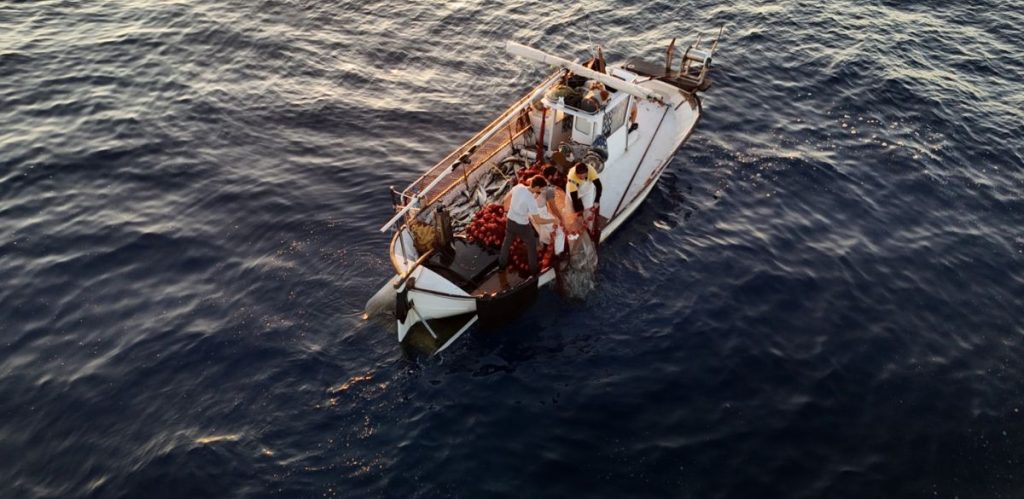
We had flat seas, little wind and endless daylight. The landscape became the entertainment. Mountains disappeared into low cloud while glaciers reached down into the sea. There was no traffic at all. Only, before leaving Disko Bay, we saw Inuit hunters pursuing seals from a small speedboat.
Crew preparation remained a constant priority. We conducted repeated man-overboard drills, rotating everyone’s responsibilities each time before discussing what could realistically be improved. In these waters, however, every exercise reinforced the same conclusion: rules one, two and three are all identical, don’t fall overboard.
We reached Upernavik, a settlement of just over one thousand inhabitants. Two more giant icebergs guarded the entrance before we could moor alongside a research vessel.
For yachts cruising Greenland’s northwest coast, Upernavik offers an important staging point before crossing Melville Bay or heading towards Baffin Bay. It is not a marina in any conventional sense, but it provides fuel, shelter and the opportunity to wait for favourable weather. That patience is often essential in the Arctic.
Time feels different here.
The only bar, restaurant and nightclub occupies what resembles a school cafeteria. The windows are blacked out for the Friday night party to simulate darkness despite the midnight sun. Only two Danish police officers cover an area stretching across numerous settlements. Boats are not recreational toys but vital transport links. Locals own boats, not for fun but to hunt and get to the next town.
Leaving Upernavik, dense fog forced us to proceed at glacial speeds. Even after the visibility improved we continued weaving through drifting ice. There was no reason to hurry. Spotting a particularly beautiful iceberg pierced by a natural arch, Captain Terje stopped the engine so we could drift beside it while eating dinner.
Later that evening we encountered two humpback whales. Once again the engine fell silent. One whale surfaced fifty metres away to inspect us while the second passed directly beneath the bowsprit. It was one of the finest whale encounters I have experienced.
North of Upernavik the scenery becomes increasingly dramatic. Icebergs seventy metres high drift silently through golden evening light while veils of mist wrap around their peaks. They rumble, crack and occasionally roll over without warning. Combined with the distant cries of seabirds and the gentle beat of our diesel engine, the atmosphere feels almost otherworldly.
Crossing Melville Bay towards Cape York brought another navigational challenge. Although there was virtually no sea ice, countless glacier fragments collected around the headland. Unlike Amundsen, who encountered dense fog and pack ice here in 1903, we sailed under full canvas. Closer to land the wind accelerated. We were extra vigilant as we discovered black ice. Icebergs that carry mountain sediment before rolling upside down are more difficult to spot among the waves.
For captains considering this route, the coastline between Cape York and Qaanaaq deserves to rank among the world’s great cruising destinations. One has to be as lucky with the weather window as we were. I have never felt such remoteness. There are no villages, no planes in the sky, no ships on AIS and often no sign whatsoever of another human presence for days. Vast glaciers descend directly into the sea while enormous flocks of little auks fill the sky. To me they look like miniature penguins. But these can actually fly.
We anchored off Qaanaaq, Greenland’s northernmost town. Just two weeks earlier our anchorage was still completely frozen up. Colourful wooden houses overlook a landscape still deeply connected to traditional hunting. Shortly after arriving, local hunters approached carrying a kayak and harpoon destined for a narwhal hunt. Later we sampled Maqtaaq, narwhal skin and blubber, which surprisingly reminded me of Japanese otoro tuna belly, rich and delicious, although the skin itself is very chewy.
Qaanaaq felt noticeably happier than Upernavik. Children played with puppies. The sled dogs looked healthier. Before departure four of us hiked to the edge of the Greenland Ice Cap itself.
A friend later asked me what it felt like being in the middle of nowhere.
I replied that we weren’t in the middle of nowhere.
We were standing at the edge of everywhere!
From Qaanaaq we crossed Baffin Bay towards Canada. Fog frequently reduced visibility below one hundred metres, demanding continuous radar watches and lookouts stationed on the bow searching for icebergs. But this was still favourable weather, unlike the Arctic gale that swept through the area once we were safely moored up. The additional hazard of big winds is that it moves the icebergs so they can drift into your vessel even when anchored.
Pond Inlet was our Canadian check-in point after crossing Baffin Bay. We continued towards Beechey Island and visited the historic graves of Franklin’s expedition. Beyond lies Peel Sound and eventually Gjoa Haven, where Amundsen famously spent two winters completing the Northwest Passage.
The Arctic rewards those willing to slow down and brave the elements. The right clothing is essential. It definitely demands respect, careful navigation and patience. But it guarantees spectacular scenery, remarkable wildlife, fascinating history and genuine remoteness.
It is a destination that truly offers the feeling that every mile sailed carries the spirit of exploration.






0 Comments