



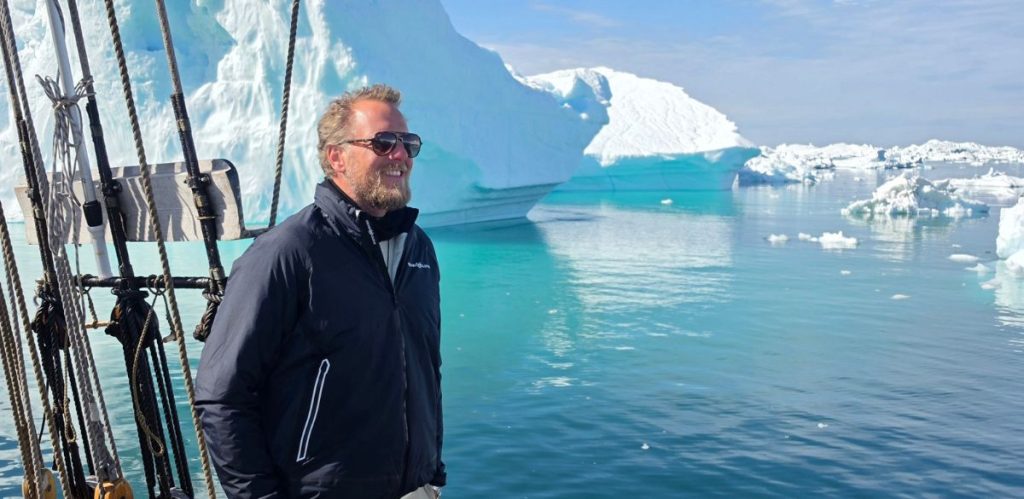
This summer I am joining an expedition through the Northwest Passage aboard Alma af Frøya, a replica of the Gjøa, the wooden, gaff-rigged vessel Roald Amundsen sailed during the first successful transit of the Northwest Passage between 1903 and 1906.
Loyal Islander readers may remember that in November last year I travelled to Norway to meet the crew, see the boat and get a small taste of what operating in those temperatures feels like. At the time it all still felt quite theoretical. Now, with my flight to Greenland booked for 17 July, it is becoming very real.
Since then I have been preparing in different ways. I’ve spent a lot of time reading about Amundsen and other polar expeditions, understanding the history gives context to the route we are about to sail. I have also spoken with a number of sailors who have completed the Northwest Passage in recent years. Like most cruising grounds, every season is different, but practical advice from people who have actually been there is worth a lot more than anything you can find online.
I’m also happy to announce that Henri-Lloyd has made me a brand ambassador and has equipped me with their top technical gear, including offshore layers, mid-layers and merino base layers. I suspect that somewhere between Greenland and Arctic Canada I will be very grateful for every layer I have!
The plan is to start in Ilulissat on Greenland’s west coast and sail north before crossing Baffin Bay towards Pond Inlet in Nunavut, Canada. From there we continue west through the Northwest Passage and onwards through the Bering Sea to Nome, Alaska.
For historical reasons we can’t miss stopping over in Gjoa Haven, named after Amundsen’s original vessel. When Amundsen overwintered there, there was no settlement. Local Inuit were living in the area and became interested in the small Norwegian vessel and her crew. Today around 1,400 people live there and the town remains closely connected to the history of Arctic exploration.
History is never far away on this route. The Oslo-based Fram Museum has asked us to keep an eye out for possible remnants of the Fram, the famous ship used by Fridtjof Nansen and later by Amundsen during his South Pole expedition. Whether there is anything left to find is another question, but it certainly adds an interesting dimension to the voyage.
We will also pass near the wreck site of HMS Erebus, one of the ships from Sir John Franklin’s failed expedition. Unlike many historic wrecks, the location of Erebus is known and, if conditions allow, we hope to do some underwater exploration there.
At the moment, the ice charts are looking encouraging. That’s good news for anyone attempting the passage, but obviously less positive when viewed in the context of climate change. The Arctic is changing rapidly. At the same time, the Northwest Passage remains perfectly capable of reminding sailors who’s in charge. In 2018, conditions were significantly colder than expected. Several yachts turned back and one became trapped in the ice, was crushed and eventually sank. The two Argentinian crew escaped over the ice.
That’s exactly what makes this route so appealing. The challenge comes from the same things that make it beautiful: ice, fog, shifting winds, cold water, wildlife and isolation. There are very few places left where nature still gets such a decisive vote in your daily plans.
For me personally, this trip will take me further outside my comfort zone than anything I’ve done before. That may sound strange after close to 100,000 nautical miles at sea, but the reality is that my sailing experience has limited relevance once you start operating at these latitudes. Everything changes. Weather routing changes. Risk assessment changes. Even simple decisions become different when the water temperature can kill you in minutes. The learning curve is a big attraction to me.
The crew dynamic will also be new for me. We will be nine people aboard a 52-foot vessel. During most delivery passages I rarely sail with more than five crew, so that will require some adjustment from everyone on board.
If all goes to plan, my part of the expedition will end in mid-September in Nome, Alaska. By then we will have completed the Northwest Passage and passed through the Bering Strait into the Pacific Ocean. Reaching the Pacific will be a significant milestone, not only because it marks the completion of one of the world’s most famous sea routes, but also because it closes a chapter that began for me many months ago in a Norwegian winter.
Another very challenging part will be being away from my family for more than two months. Having sailed with me from Mallorca to Fiji in 2025, they understand better than most why I want to do this. Even my youngest daughter, now ten years old, gets it.
People often ask me if I’m nervous. The answer is yes, a little. Not because I think something will necessarily go wrong, but because I have enough respect for the place to know that things can.
By the time you are reading this, we will almost certainly be somewhere along the Northwest Passage. Depending on ice, weather and satellite connectivity, we’ll be posting regular updates from the voyage. You can follow the expedition on Instagram via @invisiblecrew, while The Islander’s Instagram channels will also be sharing updates, photos and stories from the route as they come in.
Read part 2 : https://theislander.online/2026/10/crew-life/greenland-to-the-edge-of-everywhere-jens-oomes/






0 Comments