



For more than 50 years, Palma has stood at the centre of the Mediterranean refit industry. Its strength has long been defined by a dense network of skilled marine trades, a strategic location, and a climate that supports year-round operations.
In recent years, however, shifting cost dynamics have encouraged captains and project managers to explore mainland alternatives such as Vilanova, Denia, and Málaga for large-scale refit works. This growing competition has prompted reflection across the Balearic marine sector.
Yet, Mallorca continues to hold a distinct advantage: quality.
Across the island, a highly specialised workforce of carpenters, painters, metalworkers, and technical fabricators consistently deliver to the exacting standards expected by superyacht owners. This concentration of expertise remains difficult to replicate elsewhere in the Mediterranean.
At the 2025 Balearic Marine Cluster Forum, industry leaders highlighted three key priorities for maintaining Palma’s competitive edge: improved infrastructure, greater efficiency, and continued investment in innovation.
Increasingly, companies are responding.
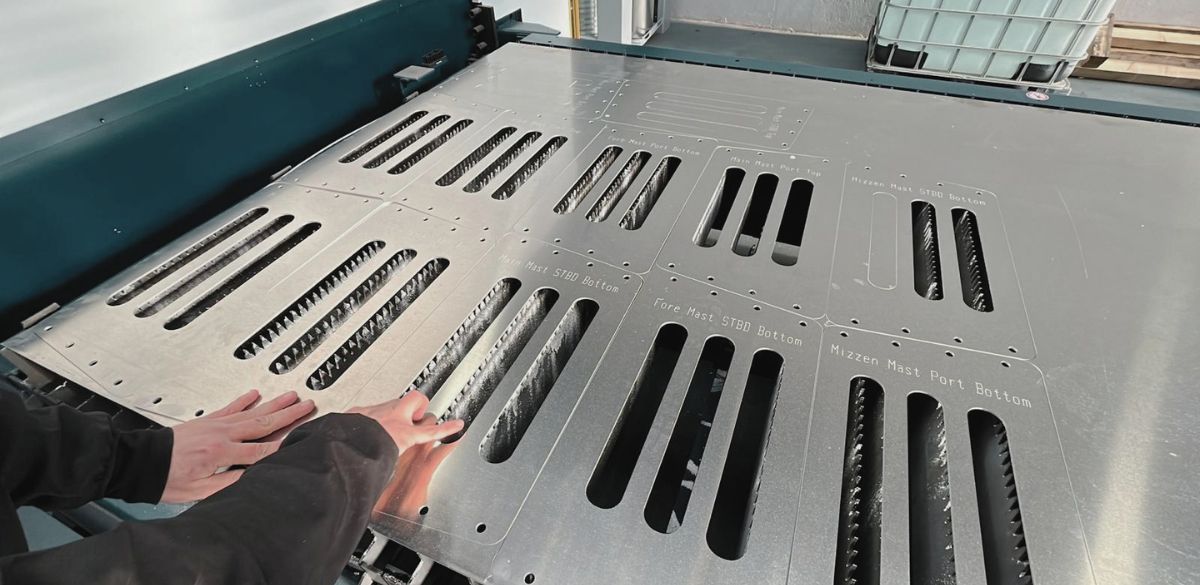
Advancements in digital design, precision manufacturing, and workflow optimisation are beginning to reshape traditional fabrication processes. In metalwork, for example, the adoption of fibre laser cutting technology is significantly improving both speed and accuracy, while reducing manual labour.
Where components once required extensive marking, cutting, and finishing by hand, they can now be produced directly from 3D models with consistent precision. This shift is particularly noticeable in commonly requested items such as Starlink brackets. By standardising designs and pre-producing base components, fabrication has moved from a multi-stage manual process to a streamlined workflow, often allowing same-day completion.
The impact on refit projects is clear. Faster production reduces bottlenecks for engineers and project managers, while improved accuracy minimises the need for rework. Lead times that once extended across several days can now be compressed into hours, supported by rapid delivery services across the island.
Precision has also improved. Modern laser systems are capable of producing complex geometries with tolerances as fine as ±0.1mm, delivering clean edges and reducing the need for secondary finishing. This allows components to move more quickly from fabrication to installation, without compromising on quality.
At the same time, the sector continues to offer the high-end finishes expected in the superyacht environment, from polished and brushed metals to advanced coatings such as anodising, powder coating, and electroplating.
Beyond the island, Mallorcan expertise is also expanding. A number of companies have established operations on the Spanish mainland, creating stronger links between Palma and key refit ports such as Tarragona and Málaga. This evolution allows the Balearic skill base to support projects across a wider geographical area, while maintaining the standards developed on the island.
For captains and owners, the result is a more balanced proposition. Mallorca continues to offer the craftsmanship and experience for which it is known, now increasingly supported by modern manufacturing methods that improve efficiency and reliability.
As the Mediterranean refit landscape evolves, Palma’s future competitiveness may not depend solely on cost, but on its ability to combine tradition with innovation. In that respect, the island remains firmly at the forefront.






0 Comments