


In the Mediterranean, spring and summer are the peak months for nautical tourism. Adding to over 25% of the world’s shipping traffic and the activity of fishing vessels, yachts make this one of the busiest maritime hotspots. Some people see this high density of yachting as a threat to the environment; we like to see it as an opportunity. And that’s why we count on fishers and sailors as custodians of the sea. Every year hundreds of yachts come across marine turtles struggling to break free from abandoned or lost fishing gear. Sometimes they are hooked, and sometimes just entangled. But in most cases they are alive, and there is a high chance of survival if the sailors act in the right way. The potential positive impact for the conservation of endangered species such as these sea turtles is extremely significant.
In this article we want to focus on a key message to sailors with regards to their situations that occur very often when we are sailing the open seas. Usually it starts with the sighting of what looks like marine litter. But when we approach it, we find that there is something caught inside the mess of netting, ropes or fishing line.
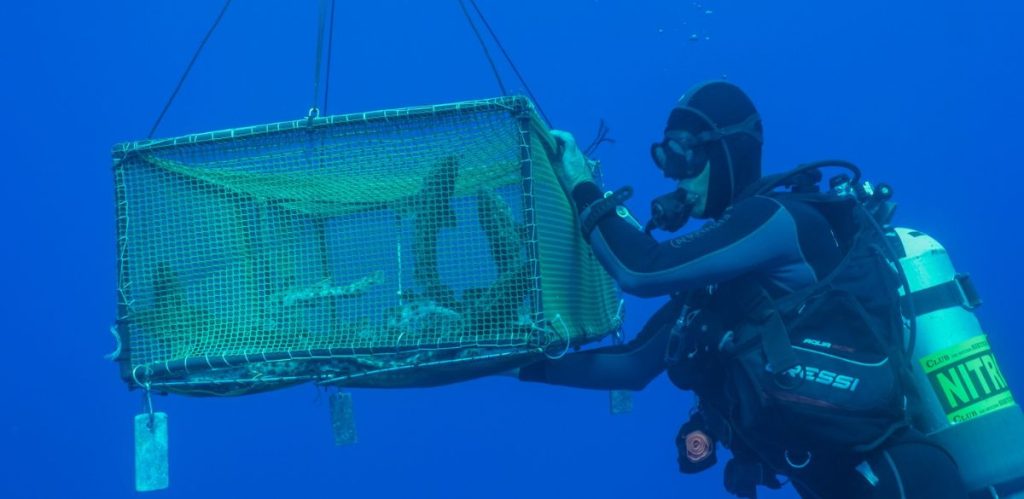
Sometimes the victim is already dead. In this case, we want to remind sailors that a date, position, photograph and brief description sent to Observadores del Mar – Pesca fantasma, mgn@gmail.com or whatsapp 0034 619108797 can be extremely useful. Our database, consisting of over 1.000.000 reports of abandoned, lost and discarded fishing gear (ALDFG) is being used as a mapping tool for the management and prevention of this risk.
Most often, what we encounter is a turtle still alive, but entangled in ropes and netting. These turtles are usually easy to haul onboard. Once on our deck we see that the animal has its line caught around the flippers and / or neck. Our instinct is to immediately cut these lines loose. But that can be a terrible mistake. As sailors we all know how a tourniquet functions when we need to use it during first aid. In the animal we have on deck, a tight tourniquet has in most cases already affected the limb badly, so if we cut loose the tourniquet we will be letting the poisonous blood from the rotten limb enter the blood stream. This will not kill the animal directly, but we will be releasing a turtle that will die shortly after from blood poisoning. So what can we do?
If we are sailing in the Mediterranean and have the possibility of entering a port, the best protocol is to call the emergency number (112 in Spain). The Mediterranean has a very extensive network of sea turtle recovery centers. If we can call the emergency services, they will facilitate everything so that the turtle can be picked up by a team of veterinarians in port so the animal can be treated with proper medication.
The same is applicable if we find a turtle that has a longlining hook ingested. Trying to remove the hook is something that must be avoided. Even if it’s in the mouth and seems relatively easy, DO NOT try to remove the hook. The mouth and tongue are very sensitive, and any injury can lead to infection and probably death. If you can take this animal to port, the rescue centers are equipped to remove the hook in adequate conditions and with the proper handling by veterinarians.
But what happens if we cannot take the injured turtle to port?
In the case of the hooked turtle, the answer is to cut the line as close to the hook as possible. In many cases of sea turtle bycatch in long lining, studies have shown that it is often the line that kills the animal. Often fishers will cut the turtle loose, but with several meters of line. Eventually, this line is ingested and ends up tearing the gut. Often we find turtles with lines coming out from the mouth and the cloaca. If we cannot take them to a recovery center, the best we can do is to cut the line as short as possible.
In the case of the entangled turtle, we must NEVER CUT LOOSE THE TOURNIQUET, but we can also cut off as much rope, lines and netting as possible. In this way, we will be putting back in the water an animal that will most likely lose its flipper, but will still have a chance of surviving. Some people may think that this does not make much sense, but the option is certainly better than condemning the animal to a terrible suffering and death by blood poisoning. In our seas, entanglement in marine litter and ALDFG is one of the main threats to sea turtles during their oceanic life stage. Very often we come across turtles missing a flipper. Usually what happens if a turtle gets entangled, is that it will stay stuck to the ALDFG for weeks. After the flipper rots, eventually it is amputated letting the turtle loose.
This turtle will probably not be able to reproduce, but it can still play its crucial role in the open ocean ecosystem as an oasis of the “Blue Serengetti”. A juvenile or subadult loggerhead turtle constructs a habitat for over 120 species, creating a bait ball for top predators such as tunas, mahi mahi, dolphins, etc.






0 Comments