


In conversation with Sara Grace Butler RN DTN BSc — Expert Yacht Medical Trainer & Intensive Care Nurse Specialist based in Palma.
“In an emergency, crews don’t rise to the level of their certificate — they fall back on what they’ve practised.”
Sara, for those who don’t know you yet — what do you do?
I’m a specialist medical trainer for yacht crew in remote maritime environments. I have been training yacht crew for over 15 years now. I am a certified intensive care specialist nurse, and worked as a nurse on yachts sailing around Europe and the Pacific for a number of years. I now train captains and crew for MSOS to confidently manage medical emergencies at sea — from everyday injuries to serious, time-critical situations.
How is yacht medical care different from “normal” land-based first aid?
On land, help is minutes away, so we often teach things like ‘hands only CPR until the ambulance arrives.’
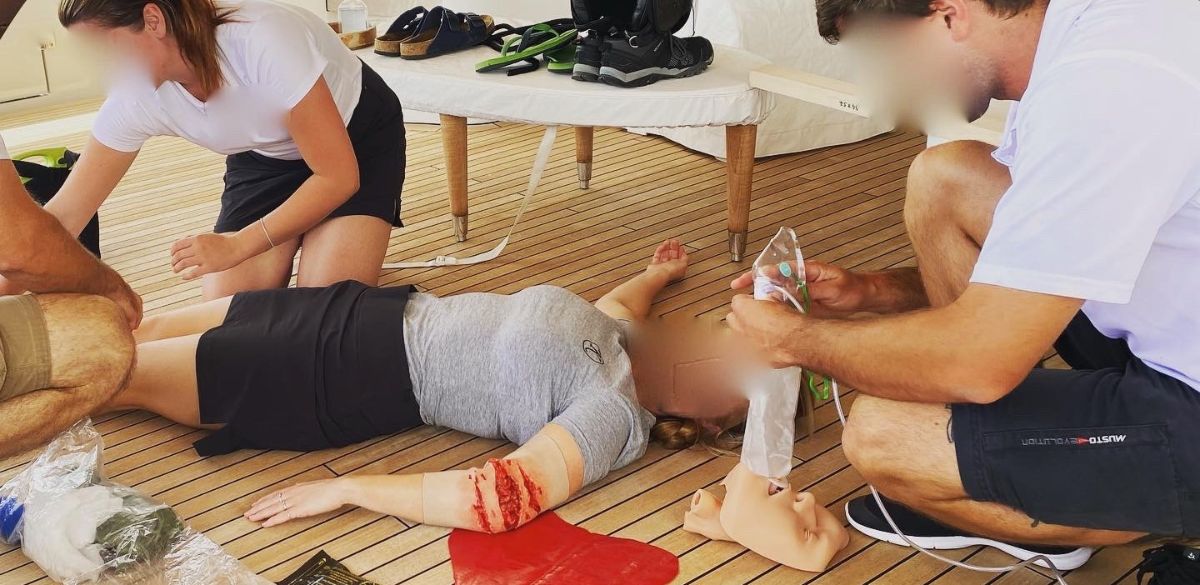
On a yacht, you are the medical response and so the training changes a lot, because there is no ambulance, no emergency department — just the crew, the medical kit, and a phone call to the TMAS ‘Call the Doctor’ service. That changes everything. Training has to be practical, calm, decision-focused, and realistic, as stress levels will be high, the injured or unwell is often a colleague and friend, and often extended care is required.
What are the most common medical issues you see onboard?
It does vary by yacht type. On sailing yachts, we most commonly see injuries to fingers, toes, and lower limbs — usually from slips and falls on wet decks, down stairwells, or through hatches. Wound infections are also common, particularly from saltwater or tropical bacteria.
On motor yachts, burns, infections, allergic reactions, and mental health concerns are frequent. But in my experience, the real challenge isn’t the condition itself — it’s recognising when something is becoming serious and knowing what to do next.
That’s where we use the RNLI philosophy of “Big Sick versus Little Sick”. It helps crews step back, assess the whole picture, and decide whether to monitor onboard, call for medical advice, or escalate to diversion or evacuation. That decision-making confidence is exactly what good training builds.
You have referred in the past to the “golden triangle” of medical care on yachts — what does that mean?
It’s the three things every yacht must have working together: a well-stocked and appropriate medical kit, properly trained crew, and access to a TMAS doctor service. If one of those is missing or weak, the whole system fails. Medical kits are useless without training, training is limited without professional backup, and TMAS can only help if the crew knows what they’re seeing and how to act. When all three are strong, yachts can manage medical situations safely and confidently.
Can you give an example of where the golden triangle worked well in a real medical scenario?
Absolutely. We recently had a case where a crew member developed severe chest pain mid-ocean. The captain was well trained and responded calmly — keeping the crew member supported and monitored — but in the back of his mind he was already preparing for a possible diversion or evacuation, which is a complex and costly decision.
He contacted the MSOS TMAS service, where a team of UK consultant-level doctors with years of maritime telemedical experience are available 24/7, 365 days a year. With a structured assessment guided by the doctors, they were able to confidently diagnose acid reflux rather than a cardiac event, and he was given the appropriate medication from the MSOS medical kits.
That outcome brought huge relief to everyone onboard and avoided an unnecessary diversion or evacuation. It’s a perfect example of the golden triangle in action — trained crew, the right medical equipment, and expert TMAS support working together to make a safe, informed decision at sea.
Why is regular medical training so important for yacht crews — beyond just certification?
Firstly, you never want to sit in a training course after a medical incident and realise how much difference better preparation could have made — not just for the casualty, but for the crew responding under pressure.
Secondly, medical guidance changes. The way we manage cardiac arrest, CPR, airway support, oxygen use, and post-resuscitation care continues to evolve as evidence improves. The latest 2025 updates from the Resuscitation Council UK need to be translated into real-world yacht practice — and that doesn’t happen through manuals alone. Crews need simulation training and regular drills to embed those updates, practise decision-making under pressure, and build muscle memory. When an emergency happens at sea, people don’t rise to the level of the course they took years ago — they fall back on what they’ve practised recently.
Finally, regulation is reinforcing this responsibility. The Maritime and Coastguard Agency has emphasised in the latest MSN 1905 amendment that captains have a responsibility to implement preventative measures for crew health. Prevention is now clearly part of the duty of care — not just reacting to emergencies, but reducing risk before incidents occur.
How do you make complex medical information usable for crew in real emergencies?
By simplifying it. In an emergency, people don’t remember paragraphs — they remember one-liners, clear visuals, and what they’ve physically practised. That’s why we focus on easy-to-remember prompts, visual protocols, and realistic simulation drills. These tools reduce cognitive overload and help crews act calmly and decisively. MSOS trainers are experts in translating medical guidance into practical, yacht-specific actions, so when pressure is high, crews don’t panic — they perform with confidence.
I personally genuinely care about crews. I want them to feel capable, supported, and safe — especially in high-pressure moments. Knowing that training today could prevent panic, harm, or even save a life tomorrow is incredibly meaningful, and I often get messages from the crew who I have trained thanking me for the training after facing a real medical incident either on land or at sea.
What impact does good medical training have on a yacht?
It protects guests, crew, and captains — but it also protects the yacht legally and reputationally. A well-trained crew responds faster, escalates appropriately, and reduces the risk of small problems becoming big emergencies.
What do you wish every yacht understood about medical training?
How important it is! It seems to come last on the list of priorities, but a study by the MCA in 2018 found that many day calls for medical emergencies exceeded all other emergencies combined!
How frequently should yachts be performing medical drills outside of pre season training with an instructor?
At least monthly! Some of my yachts do a weekly drill. For captains new to running medical drills, they can sometimes be complex. I advise a trainer to come onboard as you can learn a lot from them about the way they run their drills. Then start with handing all crew a flow chart from The Ship Captains Medical Guide or Skippers Emergency Medical Handbook included with the MSOS kit, and get them to review, then run a topic based drill such as ‘catastrophic bleeding’ run through first response and where the medical kits are located and the items are in the medical kit to respond in this scenario. If it’s your first drill be honest with the crew, this may not be perfect but if we keep practising we will become an expert medical response team!
What do you recommend yachts check when arranging medical training with a provider?
I would always ask for the medical qualification of the instructor and they should have an up-to-date medical license to qualify them to conduct medical training. They should also be experienced in maritime medical procedures, not just a land-based paramedic for example, and they should be affiliated with a maritime medical provider such as MSOS. I would also ensure that as many crew as possible are trained to the highest level, if you can conduct a three-day Medical First Aid Course (MFA) onboard for senior officers that is very beneficial, as it qualifies them to support you with advanced medical procedures such as intramuscular injections.
I know you are training most days to ensure everyone gets their pre-season training or classroom courses and the seas are safer for it, but what do you do when you get some down time?
You will find me on my road bike climbing somewhere in the Tramuntana mountains in Palma. I am currently training again for the 6 Points Charity Cycle in May which is a fantastic 3 day event. In the winter hopefully you’ll find me going just as fast on my snowboard somewhere in the Alps! If you are on a training course with me I’d love to talk about bikes or snow conditions in the breaks!






0 Comments