

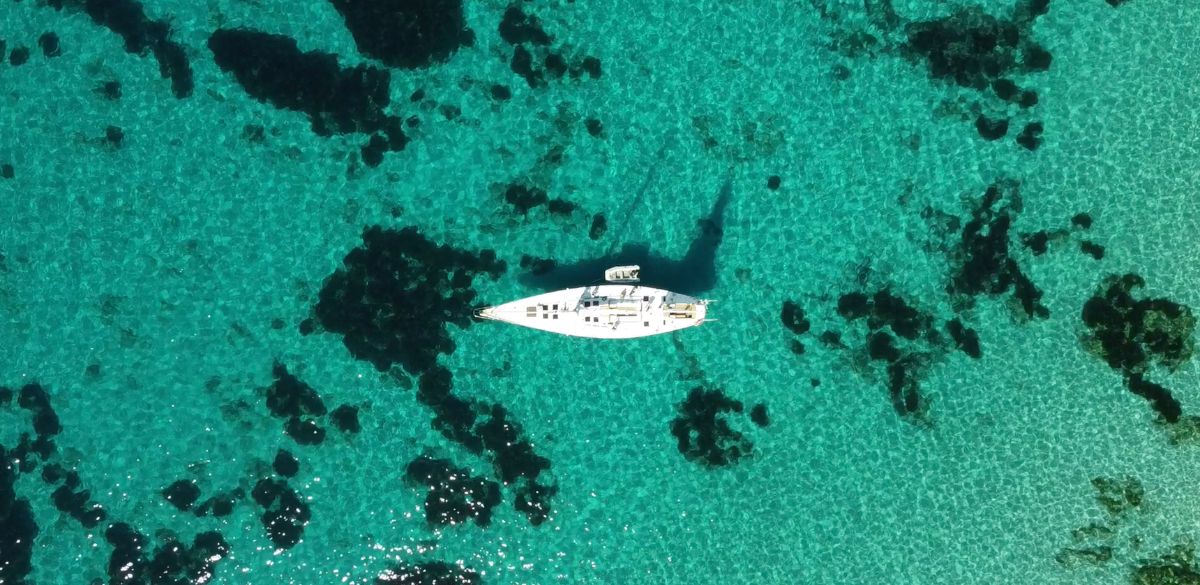


The Balearic Islands are shaped by the sea. Commercial and recreational navigation, ports and marinas, diving, fishing, and nautical tourism all form part of the same reality: intense activity above waters that conceal a seabed still poorly understood. Yet beneath some of the Mediterranean’s most intensively used waters lies a part of the marine environment that has long remained out of sight—and largely undocumented.
On the seabed, large submerged debris quietly accumulates over decades. Known locally as escombreries, this underwater waste includes ghost nets, lost fishing gear, plastics, derelict vessels, boat parts, and construction materials. Unlike floating litter, these objects can remain in place for years, particularly in bays, anchorages, and high-traffic coastal zones. In many cases, they have never been systematically located or assessed.
The implications are not merely aesthetic. In some locations, marine life adapts around submerged objects; in others, sensitive habitats such as Posidonia oceanica meadows may be damaged or placed under stress. Plastics and ghost nets can also degrade slowly, releasing trapped pollutants into surrounding water and sediments and affecting ecosystems well beyond the debris itself. Without reliable data, even well-intentioned clean-up efforts risk disturbing the seabed rather than protecting it.
Science before removal
To address this knowledge gap, TrueWorld developed and carried out a pioneering study to locate and identify seabed waste across Mallorca, Menorca, Ibiza and Formentera. The study was commissioned by the Conselleria d’Agricultura, Pesca i Medi Natural, under the supervision of the Servei de Projectes d’Espais Naturals of the Directorate General for Natural Environment and Forest Management. Its purpose was to deliver precise, actionable insight into a largely invisible but increasingly critical issue for coastal management.
The guiding principle was simple: understand before you act. Aligned with the EU Marine Strategy Framework Directive, the methodology prioritised the generation of reliable, verifiable data before any physical intervention on the seabed was considered.
Advanced technology and predictive methodology
One of the study’s most innovative elements is its use of predictive models based on mathematical correlations between satellite remote-sensing data, geographic information systems (GIS), public data sources and physical evidence collected in the field. By combining these layers, the team could anticipate where seabed debris was most likely to accumulate.
Before going to sea, probability maps were developed that integrate variables such as the location of ports and marinas, anchoring zones, fishing areas, urban centres, torrent outflows, historical records, and citizen-science contributions. These maps allow survey efforts to be targeted with precision, reducing time, cost and unnecessary environmental disturbance.
A non-intrusive view of the seabed
Fieldwork was carried out along high-precision transects, using advanced sonar technologies including CHIRP, SideScan, DownScan and StructureScan 3D to detect anomalies and generate detailed three-dimensional representations of the seabed.
Potential findings were then validated using professional remotely operated vehicles (ROVs) capable of capturing 4K video and high-resolution imagery. Each object was confirmed, georeferenced and documented together with its environmental context — depth, seabed type, and surrounding habitat — producing a robust, traceable dataset rather than isolated observations.
From data to digital twin
All collected data is integrated into geospatial databases, forming the foundation of a digital twin of the seabed. This digital replica brings together seabed morphology, habitats and debris distribution within a single, dynamic model, enabling the analysis of accumulation patterns and the testing of future scenarios.
More than a static map, the digital twin evolves over time and can be used to support marine planning, port management and evidence-based decisions on if, when and how removal or remediation should take place.
A practical tool for the maritime sector
For local and regional authorities, alongside the maritime sector, this work delivers clear, location-specific evidence to act with confidence. High-resolution seabed data supports enforcement, helps identify illegal dumping, and guides decisions on when removal is justified — and when restraint is the better option. It also marks a shift in how seabed management is approached: away from reactive clean-ups and towards long-term, data-driven stewardship.
Looking ahead
The project is now looking to expand its database across the entire Balearic archipelago, with a long-term vision of establishing a continuous monitoring system built on advanced technology, shared data and seabed digital twins. As pressure on coastal environments continues to grow, this approach represents a quiet but significant shift—moving away from decisions based on assumptions and towards managing the seabed with the same precision and confidence used to navigate the surface.
Acknowledgements
The study acknowledges the valuable contributions of Eulàlia Fons, Toni Font (Marilles), Iñaki Miniño (MAREXI), Eva Marsinyach (IME-OBSAM), Marcial Bardolet (IBANAT), Javier Rodríguez (IBEAM), and Marta Fernández (Es Nàutic Sant Antoni), as well as the Balearic Port Authority (APB), Grupo IPM (Marina Ibiza, STP), Puerto Portals, CNA, RCNP, Es Nàutic, Fundació Palma Aquarium, and the Centre Balear de Biologia Aplicada, whose collaboration was essential to the successful delivery of the study.










0 Comments