
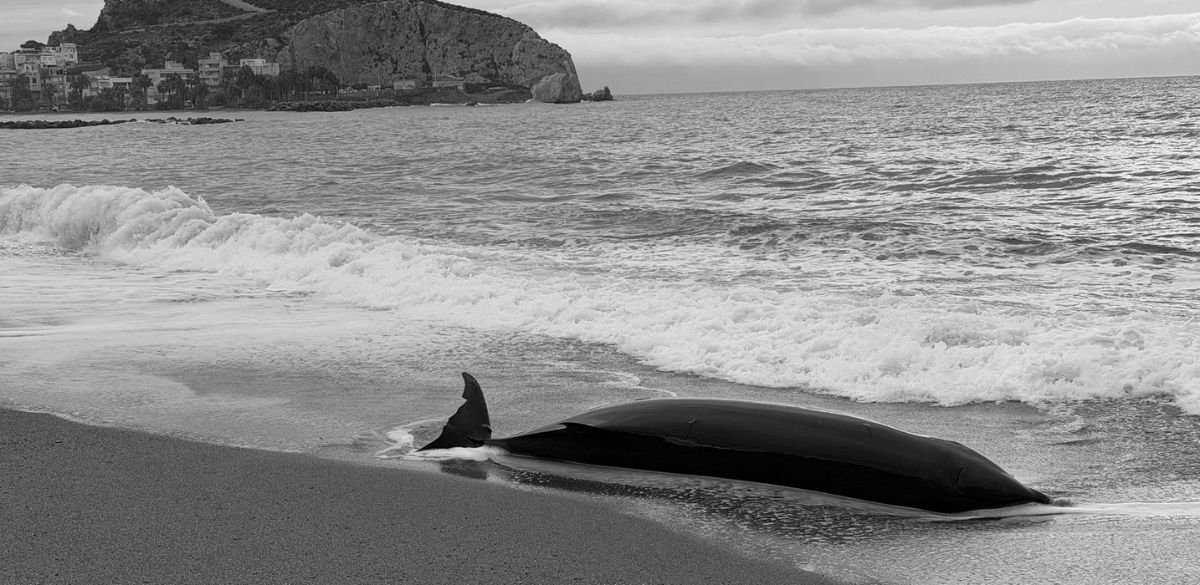


Last month, on the 23rd of January, 5 beaked whales stranded in various locations in the southwest Mediterranean. This type of stranding is usually linked to military manoeuvres using low-frequency active sonar or seismic surveys using airguns.
In this region of the Mediterranean, such strandings have not been recorded in the Alboran Sea since 2006, mainly as a result of the collaboration of the US Navy Office of Naval Research and NATO, collaborating with Alnitak in mapping high risk areas for beaked whales in the Alboran Sea.
Furthermore, as a result of this achievement, this positive example was scaled up to the entire Mediterranean basin through the ACCOBAMS agreement for the conservation of cetaceans of the Bonn Convention for Migratory Species (CMS – Mediterranean Ziphius initiative). Unfortunately, these 20 years of self-imposed moratorium by western navies seem to have come to an end last month with Spain and Morocco running a “cultural bridging exercise”.
Before motorised shipping, the oceans were the perfect environment to use sound waves as a tool for orientation and feeding. Cetaceans that colonised the oceans some 60 million years ago took advantage of this. Different species use different frequencies, being able to use sounds to feed, communicate and find their way. Some sounds we can hear, such as dolphin whistles or sperm whale clicks, but some we can’t, as they are low frequencies used to communicate and navigate over thousands of nautical miles. The noise of motors, explosions, SONAR, etc. is one of the greatest habitat alterations we have caused in the oceans.
Most species of cetacean move away from intense and dangerous noise emissions. In most cases noise does not directly kill cetaceans, but we know now that many cetacean populations have inner ear damage due to the constant shipping noise pollution that covers most of the oceans nowadays.
But why are beaked whales dying from seismic surveys and military exercises?
The answer was revealed partially by researchers such as Natacha Aguilar, who was studying beaked whales in the Canary Islands. They found that unlike most deep-diving odontocetes (toothed whales and dolphins) that decompress on the surface after diving at over 1,000 metres, beaked whales take air on the surface and then go down to around 100 m to decompress.
The reason for this could be to avoid being attacked by pilot whales or other species on the surface. Natacha’s research also highlighted how vulnerable cetaceans are during their decompression. This is something good to be aware of when we are sailing and come across dolphins or whales that appear very calm on the surface. “It seems that they are asleep and they don’t move away from us.” is a very common appreciation of sailors. Now we know that when we come across an animal or a pod that is very “slow” on the surface, they are in fact going through critical decompression, so any disturbance can be a threat to their health.
Beaked whales are very shy animals, so when they are quietly decompressing at around 100 m and a loud sound hits them and their reaction is to race for the surface, resulting in a severe decompression accident. This is why we see dispersed strandings of lone individuals or small groups of beaked whales washing ashore with internal bleeding.
In 2005, a similar stranding of beaked whales occurred in this exact place. The rapid response of researchers coordinated by Eva María Morón (Almería wildlife refuge – Sociedad Española de Cetáceos) allowed a team of veterinary specialists of the University of las Palmas (Antonio Fernández Rodríguez) allowed for a proper necropsy of the stranded animals that was a turning point as it was the first time that there was scientific proof of this type of event.
Last 23rd of January, it was lucky that the person who spotted the first whale called up Eva María. As in 2005, she coordinated the emergency response team with relevant authorities, volunteers and collaborators as crane and truck drivers or the Guardia Civil.
Antonio of ULP and veterinarian Carolina Fernandez Maldonado left aside their professional and personal agendas and took the first flights to Almería. Arriving at 2100 on the same day, the necropsies took several hours of hard work in extreme conditions. But the importance of having adequate necropsies is important now to go after responsibilities.
Why did Spanish and Moroccan frigates not take into consideration that they were operating in a hot spot of sonar risk? When NATO and the US Navy back in 2006 put in place their self-imposed moratorium to avoid the use of dangerous noise sources in these sonar risk hot spots, we always feared what would happen when other navies appeared with less sensitivity. That time has come.







0 Comments