


Obtaining a sense of purpose has become one of the most-sought-after achievements in yachting. The most exclusive experiences result in doing something new, discovering new places, and producing an impact that goes beyond just the guests on board. By creating a bond between guests and the marine world through interesting, exciting, and impactful scientific and conservation activities, the guest perspective of the experience becomes more personal and unique. Participating in scientific initiatives is one of the easiest ways to create this bond and deliver the intangible feeling of purpose.
At its root, getting a yacht to a unique, exclusive location is an act of exploration. By transiting along these often uncharted routes and visiting these secluded destinations, the superyacht fleet becomes a unique resource capable of impacting global endeavors like ocean mapping, citizen science, and whale conservation. The question now becomes, “How can a vessel and its crew actually participate and achieve this sense of purpose while maintaining the level of service expected while guests are on board?”
Many guests, captains, and vessel managers may have a romantic image, inspired by Jacque Cousteau, of what it might be like setting off on a dedicated research expedition. Though inspirational, the idea of a dedicated expedition can be daunting. Yes, yachts can do this, but they don’t necessarily have to commit to this level of involvement. At the simplest level of commitment, a yacht can participate in citizen science initiatives that are as simple as passive logging of vessel sensor data or more participatory, collecting active observations made by guests and crew.
When the development of FarSounder’s technology began over 25 years ago, my original motivation was: “How can we help ships avoid hitting rocks, causing oil spills, and avoid hitting whales, causing shipstrike casualties.” From the beginning, FarSounder’s roots have focused on marrying the operational needs of vessels with an environmental perspective. Of course, accessing the unspoiled (and often uncharted) locales along a yacht’s itinerary safely is not only important to protecting the vessel but also critical in safeguarding the environment. FarSounder’s Argos 3D Forward Looking Sonars are designed to enable yachts to access exclusive locations more safely by providing them with a clear picture of the most important piece of navigational information: What is under the water ahead of the vessel before you get there. Plus, they build a map of the ocean’s depths everywhere you go.
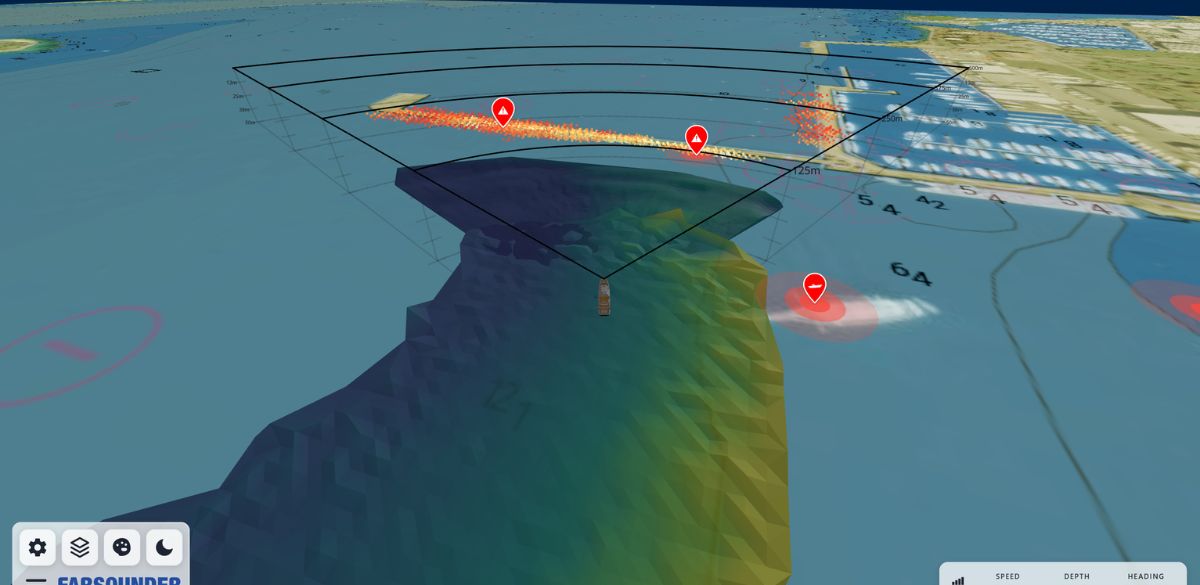
The user interface for FarSounder’s Argos 3D Forward Looking Sonars includes sonar data, nautical charts, AIS/ARPA targets, and SEA.AI target data.
The FarSounder team believes that both we and the industry have a responsibility to participate in ocean stewardship. As part of this commitment, we facilitate citizen science initiatives with anonymous data sharing functionality. A yacht can participate by passively logging vessel sensor data or, in a more participatory way, by collecting active observations from guests, and crew. For example, it is almost unbelievable that more is known about the surface of Mars than the seafloor of Earth. Only about 26% of the seafloor has ever been mapped! Seabed 2030 is a global effort endorsed by the United Nations and supported by the International Hydrographic Organization (IHO) to expand this map.
Argos sonar users can opt-in to anonymously share their depth measurements across the FarSounder fleet. In return, they receive the aggregate map from other contributors, and depth contributions are forwarded on to Seabed 2030 anonymously (via the IHO) on their behalf. For vessels without an Argos sonar installed, both the International SeaKeepers Society and the Yacht Club de Monaco offer a small device that can be connected to the vessel’s bridge equipment and used to log depth information.
As part of FarSounder’s commitment to supporting Seabed 2030 and the IHO’s CSB initiatives, the Company’s software team built an online dashboard that allows all contributors to easily view their contributions, rank themselves against other contributors, and generate simple status updates optimized for social media. The dashboard is publicly available at mycsb.farsounder.com. Though FarSounder originally developed this dashboard as an easy way for the International SeaKeepers Society and FarSounder to communicate the value of CSB to their contributors, it supports all vessels and all organizations contributing to the IHO’s program.
FarSounder’s CSB Data Explorer web app is an easy way to visualize CSB contributions
Another citizen science initiative that can involve both guests and crew is logging whale sightings. Captains are trained to think about the safety of the vessel, guests, and crew. However, there’s a broader responsibility that we should be taking just as seriously: the safety of the ecosystems we move through, including avoiding harm to whales. The two leading causes of death for baleen whales are ship strikes and entanglement. This is where the importance of contributing whale sightings comes into play.
Safeguarding whale populations is more than just protecting amazing creatures for their sake. Whales actually play an important role in the complex systems that support life here on Earth. Phytoplankton are responsible for producing 50% of the planet’s oxygen and absorbing nearly a third of human-generated carbon dioxide. A primary source of nutrients for phytoplankton comes from a process called the whale pump. This is literally driven by whales diving down to feed at depth, then returning to the surface for air, where they expel large amounts of nutrient-rich faeces. These nutrients contribute to the growth of the carbon-capturing phytoplankton blooms.
The Whale Pump process explained
Globally, marine phytoplankton capture the equivalent of four Amazon rainforests’ worth of carbon dioxide each year as they photosynthesize. A critical tool in safeguarding whale populations is to know where they are.
Not only are FarSounder’s Argos 3D Forward Looking Sonars safe for whales and benign to the marine environment, but they also include functionality to manually log visual sightings of whales and floating trash. These sightings will soon be shared anonymously with relevant conservation organizations such as Whale Alert and Eyesea.
In addition to facilitating the collection of whale sightings, FarSounder has also developed an online Whale Spotting and Safe Vessel Operation class geared towards superyacht bridge crew, guests, and anyone interested in whale-related citizen science. This class is based on all the things the FarSounder team has learned over the years while working with whales, and all profits are donated to whale conservation. Learn more at farsounder.com/whales.








0 Comments