

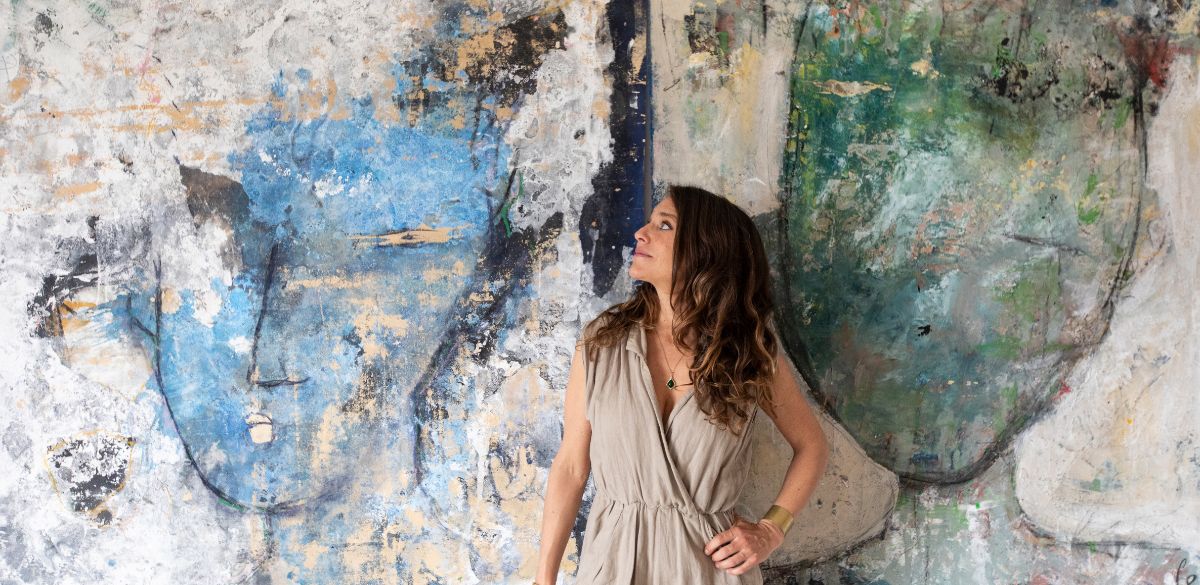


Would it be correct to say that with your paintings you leave everything open for interpretation, while your audiovisual work steers towards a clear message? What is the red thread between these two extremes?
Yes, that’s a fair observation. Painting allows me to leave space for interpretation, while my film and installation work often carries a more direct intention. But in both cases I’m exploring the same balance between control and chaos. They activate different parts of my brain, and those parts feed each other. When I paint, I let go of narrative structure. When I film or edit, I shape meaning with precision. Moving between these two modes keeps the work alive.
You were born in Mallorca but you’ve lived in LA and other parts of the world. How long have you been back in Mallorca and how do you compare it to the other places you’ve lived?
I’ve been back for several years now. Mallorca feels like returning to a base that was always there, even when I lived far away. LA and other cities gave me energy, speed, and a sense of global connection, but Mallorca gives me grounding. The rhythm here is different. There’s space to breathe and to listen, which I need for both painting and writing.
Your studio is set at the foot of the Serra de Tramuntana. Does the landscape influence your creative process, and have your paintings changed since moving here?
Yes, the landscape shapes the work—sometimes directly, sometimes quietly in the background. The Tramuntana has a steady presence, and the sea changes every day. Since moving here my paintings have become more layered and slower in their construction. The environment has taught me patience and attentiveness.
Your work often explores themes of the environment and humanity’s impact on the sea and land. In the world of luxury yachting and maritime leisure, how do you see art contributing to awareness about marine ecosystems or sustainable lifestyles?
Art can create an emotional entry point into subjects we otherwise treat as data or distant issues. Many people who spend time at sea have a deep connection to the Mediterranean, and art can strengthen that connection and remind us of our responsibility toward it. I’m not trying to preach, but I do try to create moments where viewers pause and reconsider their relationship with the environment, even in settings of comfort and leisure.
When you are painting, do you ever think of where the work will end up? Are you worried that light or location might change the experience of the piece?
I don’t think about the final location while I’m painting. I need the process to stay independent of that. Once the work leaves the studio, it belongs to the world, and light will always transform it. I actually like that. A painting is not static; it continues to evolve depending on where it lives.
Your studio is described as a simple, whitewashed building with large windows, surrounded by olive trees, pines and palms. Can you walk us through a typical day in your studio?
I start early with coffee and silence. The morning light in the studio is calm, and that’s usually when I paint in long stretches. When I need to reset, I step outside and walk among the trees for a few minutes. It helps me clear my head. If I’m working on editing or writing, I do that in a different space so the painting studio stays dedicated to the physical process of making.
Mallorca has a strong sailing and marine culture. Is there a particular moment — maybe a sailing trip, a dive, or a sea view — that has inspired one of your works?
There isn’t one single moment, but many recurring ones: watching the coastline shift from the water, or seeing the sea turn from transparent to almost black under certain winds. I’m also a scuba diver, and being underwater is almost meditative for me. Those quiet moments below the surface, when the world narrows to breath and movement, often stay with me. These transitions between clarity and opacity appear in my work again and again.
The yachting community is increasingly interested in sustainability. “Mediterranean Coral Reef” touches on this idea. Do you have clients in that world, or a desire to see your work aboard a yacht as both an aesthetic and ecological statement?
Yes, I’ve had collectors from the yachting community, and I appreciate when the work travels with them across the Mediterranean. If a painting on board can serve as a reminder of what lies beneath the surface—beauty, fragility, and consequence—then that’s meaningful to me. It doesn’t have to be didactic. Presence alone can spark awareness.
If you had to choose one ideal setting in Mallorca to reveal a new creation to a friend or client, where would it be and why?
My studio. When someone sees a new painting there, they also see the pieces around it, the traces of earlier work, and the environment that shaped it. The studio becomes part of the story. It gives context and continuity, and the new work becomes one element within a whole. That setting creates a more honest encounter with the piece.






0 Comments