


On a quiet spring morning in 2024, long before the first tourist boats stirred the waters around Cabrera National Park, a small team of marine scientists gathered on deck. Their mission was simple in theory, daunting in practice: to uncover the hidden world of sharks and rays living in one of the Mediterranean’s most pristine marine sanctuaries—without disturbing them.
This is the story of Sharks and Rays of the Cabrera National Park, a research project led by Shark Med and Save the Med Foundation between April 2024 and June 2025. Powered by patience and unwavering dedication to documenting the status of elasmobranchs, the study seeks to inform conservation and protection strategies for species—many of which are endangered in the Mediterranean.
Capturing the world below: highs and lows
Throughout the research period, which spanned a little over a year, the team used various non-invasive techniques and tools to study sharks, skates, and rays—collectively known, in science-speak, as elasmobranchs. One component of the work involved monitoring and observation of various species through cameras, while another used satellite tags to track the movements and migrations of the Spinetail devil ray (Mobula mobular). Because so little is known about this particular species, the latter served as a standalone focus of the research.
Camera action
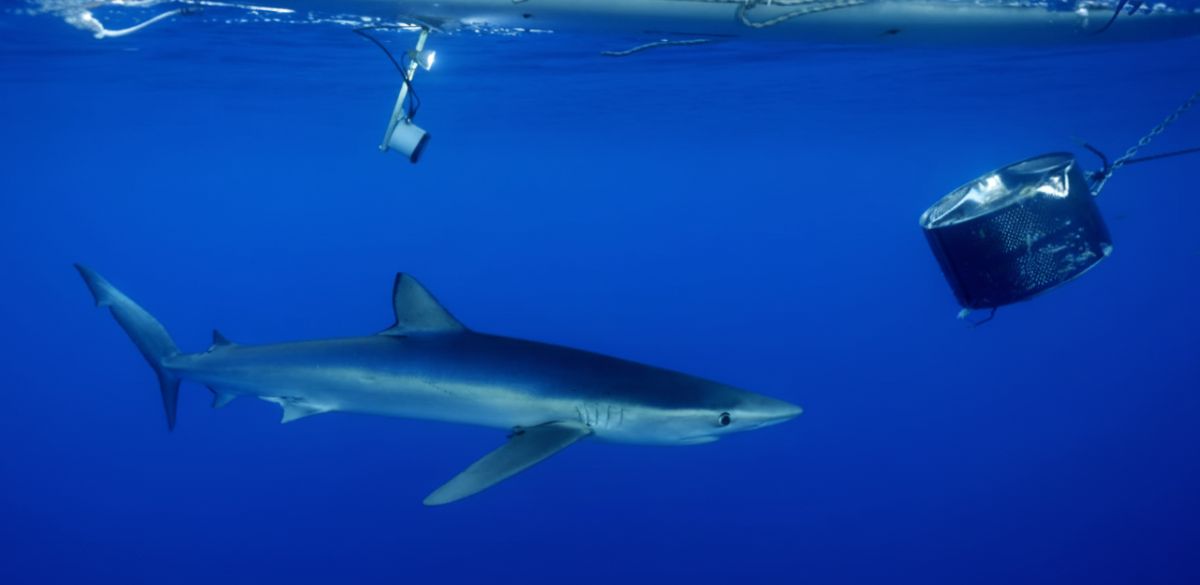
For the first component of the study, Baited Remote Underwater Video (BRUVs) devices were placed at different depths in the sea, to observe elasmobranchs in their natural habitat without interfering with 24/7 video data capture. Underwater cameras, lowered gently onto the seafloor or suspended in open water from a large, solar-powered floating surfboard, filmed the comings and goings of sharks, skates, and rays. This enabled the researchers to quantify the number of species present, monitor their abundance, and track seasonality. It is not uncommon to capture a cameo appearance by a blue shark with a fishing hook stuck in the corner of its jaw, which tells us that this species is vulnerable to nearby fishing activity, with the risk of getting maimed by fishing gear, or worse – meet its end as bycatch in a longline.
For more than 3,500 hours—day and night—the cameras rolled. What they captured was a vibrant, if unevenly distributed, community in the waters of Cabrera and the Émile Baudot seamount. In all, 606 individuals appeared in the footage, representing five species of sharks and twelve of skates and rays. Four species dominated the scenes: the Small-spotted catshark (Scyliorhinus canicula), the Thornback skate (Raja clavata), the Common stingray (Dasyatis pastinaca), and the Eagle ray (Myliobatis aquila). Together, they made up 80% of the visitors to the benthic (seafloor) BRUVs.
Yet the sea still had surprises. Gliding into view were rarities: Brown stingrays (Bathytoshia lata), usually elusive in the Mediterranean; White skates (Rostroraja alba), a threatened species; and last but not least: Bluntnose Sixgill sharks (Hexanchus griseus), deep-sea giants appearing unexpectedly close to 90-metre depths.
And then there were the absences—species like the Common smoothhound (Mustelus mustelus) that the team expected to see in abundance, but hardly appeared at all.
In the open water, the story shifted. Pelagic sharks were sparse. Only 17 Blue sharks (Prionace glauca) were filmed over months—a mere one individual every six days. Then, one day, the cameras captured something extraordinary: the first underwater footage of a shortfin mako (Isurus oxyrinchus) ever recorded in the Balearic Islands. A fleeting moment, but a historic one.
Following the spinetail devil rays
If the BRUVs were the eyes of the project, satellite tags became its long-distance messengers.
In July 2024, three Spinetail devil rays (Mobula mobular)—graceful, threatened giants of the Mediterranean Sea—were fitted with miniPAT satellite tags. The tags would detach after weeks or months, drift to the surface, and beam home stories of the rays’ journeys. The data revealed the devil rays’ life spent on the move, with recorded migrations of up to 750 kilometres and plunges into the deep blue reaching depths of up to an incredible 700 metres.
Invisible clues in every drop
Alongside cameras and satellite transmitters, the team collected another kind of evidence—something that couldn’t be seen at all.
Environmental DNA, or eDNA, captures traces of organisms shed into the water: skin cells, mucus, tiny fragments that serve as genetic breadcrumbs. These samples, still being processed, promise to reveal which species passed through each site—even those that evaded every camera.
Once complete, the eDNA analysis may provide the most comprehensive picture yet of Cabrera’s elasmobranch diversity, and tell a more hopeful story.
Both the results and the experience carried highs and lows—surprise, hope, and concern woven together—feelings the researchers carry with them as they work to raise awareness and deepen public appreciation for these remarkable and crucial animals of the open sea.
Why this matters
The Balearic Sea is home to a staggering 32 species of sharks, 27 species of rays, and 1 species of chimaera. Yet, despite their importance to the marine ecosystem, almost half of these species are threatened with extinction.* To develop a truly holistic conservation strategy, it is essential to thoroughly understand not only the current state of the marine ecosystem and the endangered species within it but also to challenge the widespread myth of sharks as dangerous predators, a fear fuelled by popular beliefs and folklore.
The waters surrounding Cabrera National Park, and the nearby Émile Baudot Seamount rising 90 metres from the deep, provide refuge for some of the Mediterranean’s most threatened species. But without knowing who lives there—and how they move, feed, and migrate—conservation efforts are flying blind.
This project, supported by the EU’s Recovery, Transformation and Resilience Plan (PRTR), the Regional Ministry of Agriculture, Fisheries and Natural Environment, and with notable collaboration from the Marilles Foundation, provides exactly the kind of knowledge needed to protect these fragile communities.
By pairing modern tools with minimal disturbance, Shark Med and Save the Med are charting a path forward: research that respects the sea’s inhabitants while revealing their hidden lives.
Looking ahead
As the final eDNA results come in and satellite tags continue collecting data, the team is already thinking beyond Cabrera. Their research forms part of a broader effort to understand elasmobranchs throughout the Mediterranean—a sea basin where sharks and rays have declined more than in almost any other region on Earth.
But for now, Cabrera remains a beacon: a place where science is shedding light on creatures older than the dinosaurs, still carving their paths through the Mediterranean’s blue depths.
And thanks to a few cameras, a few tags, and a great deal of dedication, we are finally learning their stories.
*According to the 2022 IUCN Red List of Marine Mediterranean Fish, 40% of native sharks, rays and chimaeras (i.e. Chondrichthyes) are regionally threatened with extinction.









0 Comments