


The European Resuscitation Council’s 2025 Guidelines on Cardiopulmonary Resuscitation were launched on 22 October 2025 and are designed to tighten the earliest, most time-critical links in survival: fast recognition, immediate CPR, and rapid defibrillation.
The time advantage: why the first 3 minutes matter
In resuscitation, time is survival. The critical point for crew to hold in their minds is this:
- The “most savable” casualties are those who receive CPR and AED Shock in the first 3 minutes. Survival drops rapidly for every minute without effective CPR/defibrillation—7–10% per minute without bystander CPR in shockable rhythms, so after 5 minutes we are down to a 50% survival chance.
- According to the updated data, in well-functioning systems, ambulance response targets for immediately life-threatening calls are around ~7 minutes, and real-world averages are often 7–8 minutes or more.
For yacht crew, the message is even sharper because we operate in a unique environment, which is both positive and negative for medical response – we are far from an ambulance on a moving hospital, but we are usually closer to the casualty than any shoreside responder, and our key CPR equipment (AED, Oxygen, BVM, suction) is often minutes—or seconds—away. That proximity is a genuine advantage, but only if we are trained, confident, and drilled to act.
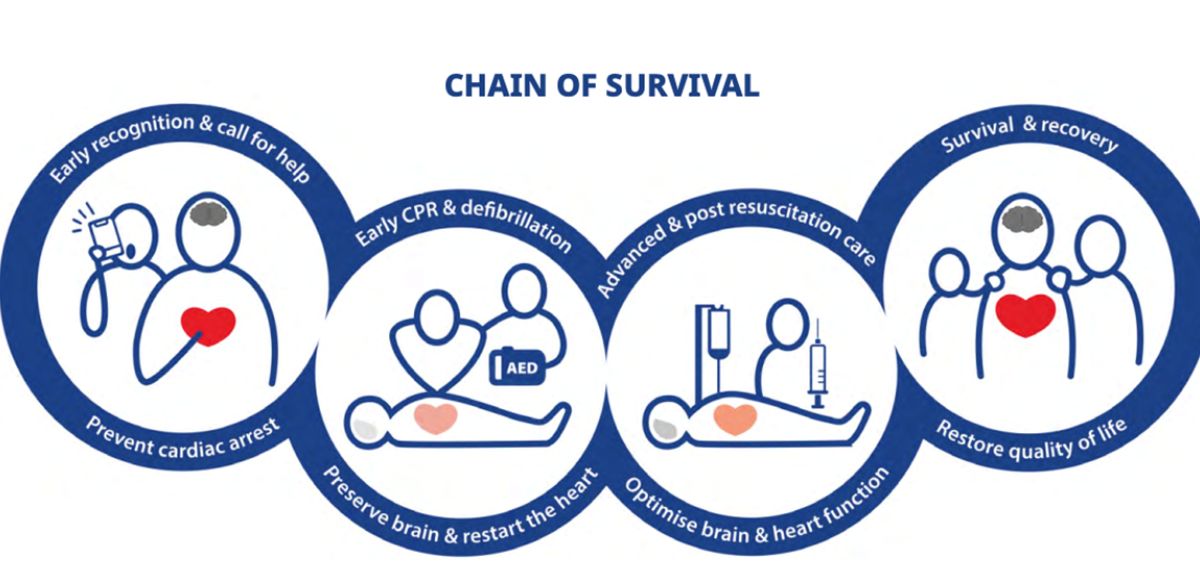
THE REVISED CHAIN OF SURVIVAL (ERC 2025)
ERC has revised the Chain of Survival into four “rings” reflecting the full journey:
- Prevention + Fast Recognition – Ensure crew know the reversible causes for stopping breathing and how to treat – choking, heart attack, anaphylaxis etc. Ensure all crew know their DRABC protocol well enough to teach it to someone else at all times – drill hard!
- Early CPR + Defibrillation (together) — the two lifesaving basics combined into one ring, highlighting that compressions and shocks are inseparable priorities. Ensure crew know how to perform high quality CPR by getting an MSOS trainer on pre season to drill them, and run surprise drills to ensure crew can get a defib to all areas of the vessel in under 3 minutes, get supplementary defibs on larger vessels.
- Recovery and Survivor support – work with your MSOS TMAS (call the doctor service) for recovery while onboard, and logistical support for evacuation. Ensure crew know how to stabilise injuries, and how to treat shock.
CPR HIGH BMI CASUALTY UPDATE:
- Access: open clothing early, ensure you are compressing the centre of the chest (sternum), and rotate compressors more frequently if fatigue is high. Press down harder, aim for 5-6cm depth on larger casualties.
- Airway/ventilation: obese casualties may be harder to ventilate—use two-person BVM technique, adjuncts (OPA/NPA where trained/indicated), and oxygen early.
CHOKING PROTOCOL UPDATE (adult and paediatric): “alternate 5 and 5”
- Recognise Choking, Act Quickly, no sound means no time! Ensure crew know the international sign for choking (hands around the neck) and to check those who quickly and silently leave the dining table.
- Say ‘Keep Coughing!’ The casualty’s best way to start to clear the airway
- Give five back blows in between shoulder blades, upward thrust, increase firm pressure with each blow.
- Give 5 abdominal thrusts (for adults/children >1 year). First make a fist, put your arms under theirs from behind, place thumb just above belly button, other hand on top, and thrust in and up, increasing firm pressure with each thrust. Think about anatomy, if available choose a rescuer a little taller and stronger than the casualty.
- If pregnant or large belly, do a chest thrust, same action but on the sternal bone
- If not relieved: continue alternating 5 back blows and 5 abdominal thrusts until relieved or the person becomes unresponsive.
- If the casualty becomes unresponsive: start CPR protocol.
HOW TO IMPLEMENT THE CHANGES ONBOARD (a practical 30–60 day plan)
STEP 1 — Update your written SOPs (Week 1)
- Replace chain of survival and choking infographics and display in galley, crew mess, bridge.
- Print out infographics or flowcharts from the Skippers Medical Emergency Handbook or Ship Captains Medical Guide 2-3 days prior to drills, ask crew to revise and then run a topic based drill.
STEP 2 — Re-map equipment for “seconds, not minutes” (Week 2)
Do a timed walk-through: “collapse in each zone.” Your aim is to know you can get hands on chest in <60 seconds and AED at side in <3 minutes in all locations onboard. Use your yacht’s layout to your advantage.
- AED: consider two AEDs on larger vessels or high-risk layouts.
- Oxygen/BVM: Ensure all crew know how to apply a Bag Valve Mask (Ambu Bag) with a CE grip and how to connect up oxygen.
- Comms: clear plan for calling TMAS service, what to say, and how to document timeline of CPR.
STEP 3 — Drill to the new priorities (Week 3–6)
Run short, high-frequency drills, preferably with trainer defib and manikin.
- 3-minute drill: collapse → CPR started → AED attached → first shock (if advised).
- Choking drill: transition from effective cough → ineffective cough → 5/5 alternating → unresponsive → CPR.
- Run an MSOS onboard training day which includes simulated drills and latest updates to ensure best level of preparedness.
STEP 4 — Debrief and measure (ongoing)
After each drill, capture
Time to first compression, time to AED attachment, compression quality feedback (if your AED provides it), and role clarity (who did what without being told).
Have a no blame training policy, if people speak up about things they would do differently, we can learn and develop.
THE BOTTOM LINE FOR YACHT CREW
Medical incidents occur more frequently than any other emergencies on board sadly.
If you and your crew are well trained, you can respond safely, quickly and efficiently to a medical incident even under your fight-or-flight response, so drill hard!
MSOS are here to support you with any of your medical training requirements, on board or in the classroom for both first response and advanced courses. Please get in touch to book your training or support with your medical system – sally@msos.org.uk
Guidelines referenced are aligned with the European Resuscitation Council 2025 recommendations and supporting international resuscitation science.









0 Comments