

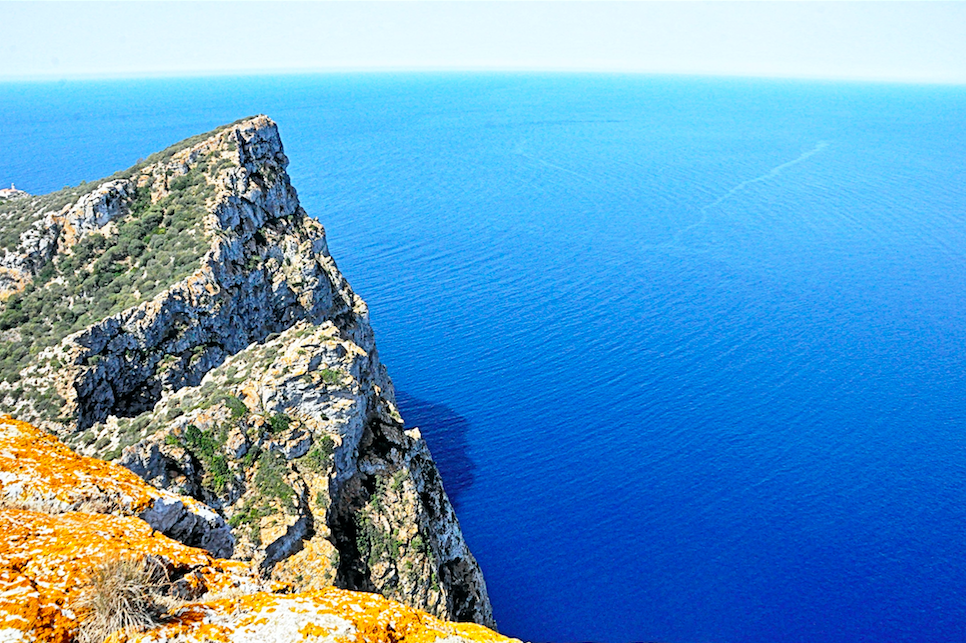
 Sant Elm is a small resort at the south-west tip of Mallorca. It is named after Sant Elmo, the patron saint of sailors. Today, yachts anchor in the calm waters between the coast and Dragonera Island but there was a remarkable gathering of vessels in the bay in 1229.
King’s James I of Aragon planned to conquer Mallorca and his fleet left Salou, near Tarragona on the mainland, on 6 September and ‘the sea seemed white with sails, so large a fleet was it’. The plan was to sail past Formentor Peninsula, at the north-east corner of the island, and land in Pollença bay but a storm and scattered the ships. The king’s sea captain wanted to turn back but he refused.
After two days of being tossed around like corks, the Tramuntana Mountains were spotted on the horizon at sunset on the second day. The king’s advisor suggested sailing to the south-west corner of the island where there was a sheltered bay. There was also an island where they could get fresh water and rest the horses.
 The fleet assembled in St Elm bay but they were not alone because 5,000 armed Moors were waiting on the shore. So the king’s entourage pitched their tents on the tiny island of Pantaleu, close to the shore, and waited for dawn. One Moor swam across to the island during the night and gave information the island, helping the king to make a new plan.
The following day King James instructed his assistants, Guillem de Montcada and Nuno Sancho, to find a place to land and they returned, having found what we now call Santa Ponça and Magaluf beaches. The fleet sailed that night; all 150 vessels. There were seventeen galleys carrying the knights and their followers and they towed twenty-five transports loaded with the foot soldiers. The horses were on board 100 brices and galliots, while eighteen taridas carried the siege equipment. A number of barques were filled with stores. But what happened next is a story for another time…
 Many years later, a sailors’ hospital was built on the coast, resulting in the name Sant Elm. A fortified tower was added when Mallorca came under attack from the Ottoman Empire during the 1500s. The garrison checked out anyone who landed on the isolated beach, to make sure they did not attack nearby Andratx.
Dragonera Island or Dragon’s Island is just off the coast and the outline of the island resembles a sleeping dragon. But it is also home to thousands of tiny dragons, or rather lizards. People have lived on the island since pre-historic times. Over the centuries furnaces were built and trees were burnt to make charcoal for fires. Kilns were also built to burn limestone, creating lime for mortar and whitewash. Farmers raised cattle and grew crops while their wives made baskets from palm leaves. Falcons were captured during the medieval period, when falconry was popular with the nobility.
 Two watchtowers were built on the island, one on the highest point and one at the south-west end, during the Ottoman threat. They used fires to warn the garrisons of St Elm tower and San Carlos castle near Puerto Andratx if a pirate fleet approached. But the farmers left one by one until the island was deserted, apart from the families who manned the three lighthouses. They burnt olive oil to make the first lights but solar power now runs the automated lanterns.
There was pressure to build on the island during the tourist boom in the 1970s but the locals fought the planners and saved they Dragonera from development. The Consell de Mallorca bought the island in 1987 and it was turned into a ‘Natural Area of Special Interest’; the island and surrounding waters were made into a Natural Park in 1995.
 Sa Dragonera Natural Park is made up of three islets, Dragonera, Pantaleu and Mitiana. The island’s rocky slopes and dry climate give the island a rich array of flora. There are over 350 different plant species; eighteen of them are unique to the Balearic Islands. Small lizards can also be seen everywhere if you look closely. They are inquisitive little creatures and they will come and check you out if you stop to have a picnic.
Ornithologists visit what is an ‘Area of Special Protection for Birds’. But anyone can see the many species of sea birds which nest on the cliffs and watch their antics as they soar in the breeze. You may see the Audouin gull or the Balearic shearwater, a bird only found around the Balearic Islands. There are also several types of birds of prey, including a large number of Eleonora falcons, a bird which spends its summers on the island and its winters on Madagascar.
You have to cross the channel of water, which is 800 m wide and up to 15 metres deep, to get to the island. You can  catch either a ferry from St Elmo or take a boat trips from the nearby resorts if you want a longer sea voyage. The surrounding seas are a ‘Site of Community Importance’ and the sea floor is a thriving ecological landscape covered with Neptune Grass. It is home for a wide variety of marine species and corals.
There are four walks on the island; a short one around the harbour area, and one to each of the three lighthouses. If you head to the northern point, look across to the mainland to see the Trappist monastery of Sa Trapa. Monks escaping the French Revolution at the end of the 18th Century built a tiny monastery and terraces so they could live off the land. They left in 1820 and the monastery fell into ruins. The Friends of Trapa and the Balearic Ornithological Group recently bought the area and they are in the  process of restoring the monastery and surrounding area.
For more stories like this, visit www.mallorcadaysout.com






0 Comments