


Pre-historic man lived in a walled settlement on Can Bassera Hill, two miles to the west of Alcúdia. The Romans arrived in Mallorca 123 BC and they wanted to use the two large bays on the north-east coast, so they decided to build their capital on the peninsular between them. They called it Power or ‘Pollentia’ in Latin. It could become the capital of Insulae Baliarum, the Balearic Islands. The word ‘major’ in Latin means ‘greater’ while ‘minores’ means ‘lesser’… hence the names Mallorca and Menorca. In case you are wondering, Palma was a military encampment and Campana Palma translated as Camp Victory.
Pollentia became an important trading post in Roman Spain, or Hispania, and it was larger than Alicante and nearly as  large as Barcino (now Barcelona). The two largest buildings were the temple and the merchants’ exchange and it had a forum, an amphitheatre and a wall to protect the inhabitants. Pollentia grew into a prosperous place until a fire and riots reduced the population around 200 AD. It had been abandoned by the time Vandal pirates terrorised the island at the end of the 5th Century.
Gabriel Llabres and Rafael Isasi found the ruins in 1925 and archaeologists have spent over seventy-five years investigating the site. Large parts of the town are now exposed and you can walk around them. The entrance is opposite St James’ Church and there is a large car park next to the entrance. Check out the displays explaining life in Pollentia by the entrance before you start exploring the ruins. Then follow the marked gravel path through the ruins to the small amphitheatre.
 The Moors conquered Mallorca in 902 AD and they placed the area under the control of Bullensa, their version of Pollentia. Farms were built around the old Roman town, using stones from the demolished buildings and a large farm called Al Kudi, or The Hill in Arabic, gave Alcúdia its name.
Very little happened following the conquest by King James I of Aragon in 1229 until King James II decided to build a fortified town on the site, as the major stronghold for the north-east area. He sold off land, granted a market license and gave land for a church. The plan was to rename the new town Saint James but the locals stuck with the Arabic name.
The walls were eventually finished in 1362 and they surrounded a medieval town which had merchants’ houses and  warehouses, alongside boat builders workshops and fishermen’s’ hovels. It was a thriving place but the new wall and harbour made the neighbouring villages jealous.
Alcúdia served as refuge whenever this part of the island was under threat and it became the focus of a civil war during the Brotherhood Uprising. The peasants demanded lower taxes and they besieged the local barons in the town in December 1521. It ended when a royal fleet carrying Imperial soldiers landed in October 1522 and slaughtered the population of Pollença to cow the rebels into surrendering. Their brutal plan worked and the rebellion soon ended.
 The island was attacked by Ottoman fleets in the 16th Century and it was Alcúdia’s turn on 27 October 1551. Lieutenant of the Watchtowers, Bartholome Maura, ordered the town garrison out when a fleet was seen approaching. They ambushed the Ottoman as they prepared to attack and they fell back to their ships and rowed away. King Phillip II came to the Spanish throne in 1556 and he had the town protected by an earth embankment, a new wall and a moat.
Another attack on the town, in 1559 also failed to breach the town walls. But people of Alcúdia faced hard times as plagues and famines reduced the population until King Charles III decided to invest in the port in 1779. His aim was to increase international trade to improve the local economy and incite new industries into the area.
The first tourists arrived in the 1920s but the Spanish Civil War and the Second World War halted business in the  1930s and 40s. The tourist boom really took off in the 1970s and while there are now 16,000 living the town and port, making it the second largest town after Palma, there are nearly 30,000 hotel places in the area.
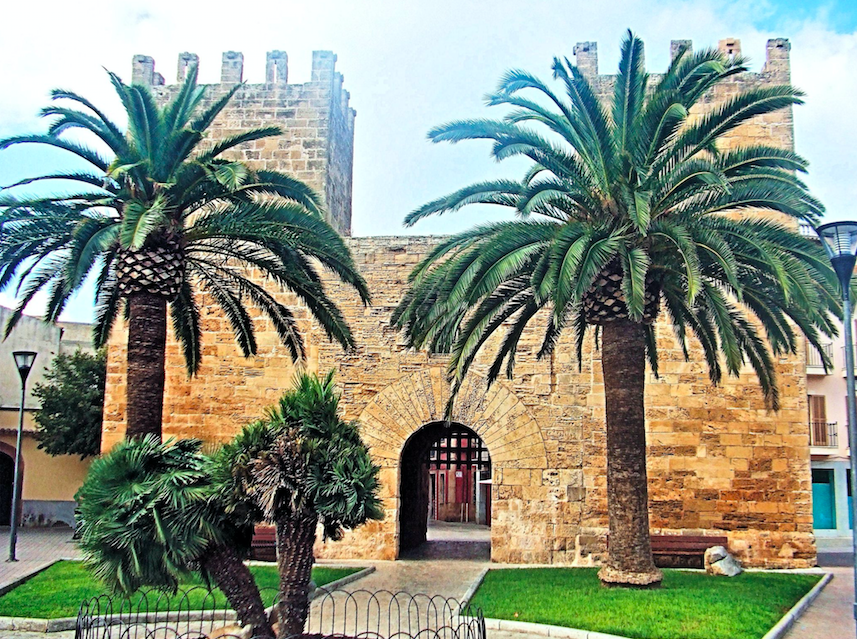
You can walk along parts of the 1.5 kilometre long medieval wall, starting from the Moll Gate or Quay Gate on the east side. Note the memorial to the siege in 1522, which remembers that Emperor Charles I granted the title ‘The Beautiful Town’ to Alcúdia for protecting the island’s barons from the rebels. Head right, following the wall past the site of the King’s Bastion where you can see King Phillip’s extra fortifications. Continue to the Queen’s Bastion at the north corner of the town where you can see the town’s bull ring, a small, rough and ready affair.
 Continue around the walls past the site of St Fernando Bastion and Santa Maria Bastion before passing the Red Gate at the northern corner of the town. You can climb steps and walk along the top of the next section of the wall, past St Felipe and St Luis bastions, enjoying the wonderful views over Pollença Bay.
Head inside the walls to visit the 15th Century Church of Saint James. Inside you will see the large rose window, the image of St Sebastian and a small museum of church art.
From the church walk east along Calle Rectoria, turning left half way down into Calle Albanales (Calle de Albellons), past some fine manor houses. Turn right in the plaza, next to the elegant early 20th Century town hall. You are now on Calle del Moll, a street of restaurants, cafes and shops where you can rest after your walk. Continue east, back to your start point, the Quay Gate.





0 Comments